TypixDeck Overview
TypixDeck is a pocket-sized cyberdeck built around a Raspberry Pi Compute Module 4 / 5, with an ESP32-S3 co-processor that handles power management, the USB sound card and the built-in status display, and an STM32-based QMK keyboard.
Specifications
Section titled “Specifications”| Item | Detail |
|---|---|
| Compute | Raspberry Pi CM4 / CM5 (2 × 100-pin board-to-board) |
| Display | 3.2“ 1024 × 768 IPS, capacitive touch, 400 PPI |
| Keyboard | 6 × 11 matrix, STM32F042, QMK, USB HID + I2C |
| Co-processor | ESP32-S3 (8 MB Flash + 8 MB PSRAM): power monitor, USB audio, local GUI |
| Storage | M.2 2230 NVMe (PCIe Gen2 x1) + microSD |
| Ports | 2 × USB 3.0 Type-A, USB-C host, USB-C power, micro HDMI, 3.5 mm audio, CSI-2 camera |
| Audio | ES8389 codec, 2 × MEMS mics, 2 × class-D amps, stereo speakers |
| Battery | 3.7 V 604070 Li-Po, 2200–2400 mAh, 3.5 A charger |
| Extras | 6-axis IMU, RTC with backup cell, PWM fan controller |
Board layout
Section titled “Board layout”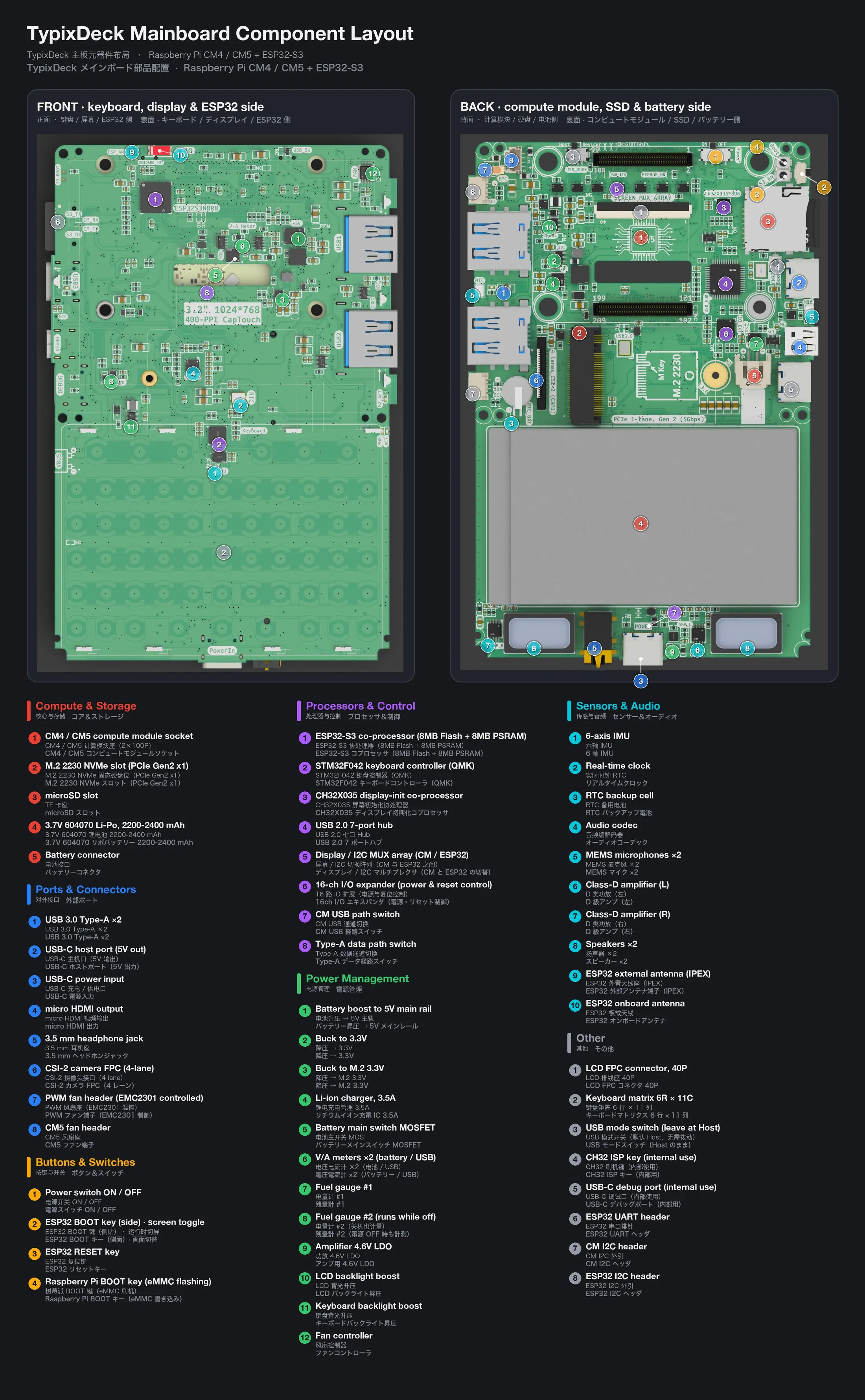
Markers are grouped by colour, from what you are most likely to need to what you will rarely touch:
| Colour | Group |
|---|---|
| 🔴 Red | Compute & storage — compute module socket, NVMe, microSD, battery |
| 🔵 Blue | Ports & connectors |
| 🟠 Orange | Buttons & switches — power switch, ESP32 BOOT / RESET, Pi BOOT |
| 🟣 Purple | Processors & control — ESP32-S3, keyboard MCU, USB hub, display MUX |
| 🟢 Green | Power management |
| 🩵 Cyan | Sensors & audio |
| ⚪ Grey | Other — internal-use ports and headers |
The buttons you actually need are the orange ones; see Flashing firmware for how they are used.
Open source
Section titled “Open source”- ESP32-S3 firmware: https://github.com/TypixNode/TypixDeck-esp32s3-firmware
- Keyboard firmware (QMK): https://github.com/TypixNode/TypixDeck-keyboard-firmware
- Schematics & netlist: https://github.com/TypixNode/TypixDeck-schematics